If your vastus medialis is screaming after a 60-mile ride, the right cold therapy quad wraps for cyclists with VMO strain can shave days off your recovery. This 2026 guide compares motorized ice machines that deliver continuous, temperature-controlled cooling to the inner quad—where lazy VMO firing patterns and over-recruited vastus lateralis muscles create the burning, deep-knee ache cyclists know too well. Below you'll find four real, currently available systems, a side-by-side spec table, and a clinician-informed protocol for using them after long base-mile blocks or interval days.
Why cyclists develop VMO strain in the first place
The vastus medialis oblique (VMO) is the teardrop-shaped slice of your quadriceps that sits just above the inner edge of your kneecap. It's the only quad fiber group that fires hard during the last 15 degrees of knee extension—the exact arc cyclists rarely reach on the bike. Hour after hour of pedaling in a 90–110 degree flexion window leaves the VMO chronically under-loaded while the vastus lateralis grows dominant. The result is the classic cycling presentation: medial knee tenderness, a deep ache along the inner quad after long rides, occasional patellar tracking issues, and a slow, grumbling strain that flares whenever volume jumps.
Ice alone won't fix a strength imbalance, but well-applied cold therapy in the first 24–48 hours after a flare-up does two important things. It blunts the inflammatory cascade so you can sleep without throbbing, and it lets you keep training base miles while you address the underlying VMO weakness with terminal knee extensions, step-downs, and single-leg work off the bike. For an in-depth breakdown of the rehab side, see our companion piece on VMO strengthening exercises every cyclist should add to their off-bike routine.
What to look for in a quad-friendly cold therapy machine
Most cold therapy machines on Amazon are marketed for post-op knee surgery. That's good news for cyclists—the same anatomically shaped knee/thigh pads that hug a meniscus repair also wrap beautifully around the distal quad and VMO. When shopping specifically for cycling recovery, prioritize:
- Pad coverage that extends above the patella. Standard knee wraps that stop at the kneecap miss the VMO entirely. Look for pads marketed as knee & thigh or large universal so the cuff sits 3–4 inches above the upper pole of the kneecap.
- Programmable timers in the 10–30 minute range. Continuous cold for more than 20 minutes risks skin and nerve issues; a timer that auto-shuts is safer than a manual unit.
- Reservoir size of 6 quarts or larger. Small chambers ice up in 25 minutes, leaving you cold-cycling mid-session. Cyclists icing both quads back-to-back should size up.
- Quiet operation. You'll likely use this on the couch, in bed, or after a 5 a.m. ride. Anything louder than roughly 50 dB becomes unbearable across a 20-minute session.
- Sealed circulation, not gravity feed. Pump-driven systems hold a consistent 38–45°F across the pad; gravity bags get warm in the middle of the wrap by minute eight.
2026 comparison: top cold therapy machines for cyclist VMO recovery
| Model | Reservoir | Timer | Best for | Noise |
|---|---|---|---|---|
| CF-3 Pro 16.8QT | 16.8 quarts | Programmable | Long sessions, both legs | Low |
| CF-1 Quiet System | ~6 quarts | Programmable | Bedroom & travel | Very low |
| ACL Recovery Ice Machine | ~9 quarts | Manual | Budget post-op style use | Moderate |
| Portable Programmable Timer | ~7 quarts | Programmable | Race travel, hotel rooms | Low |
The best cold therapy machines for cycling VMO strain in 2026
1. CF-3 Pro 16.8QT — best overall for high-volume cyclists
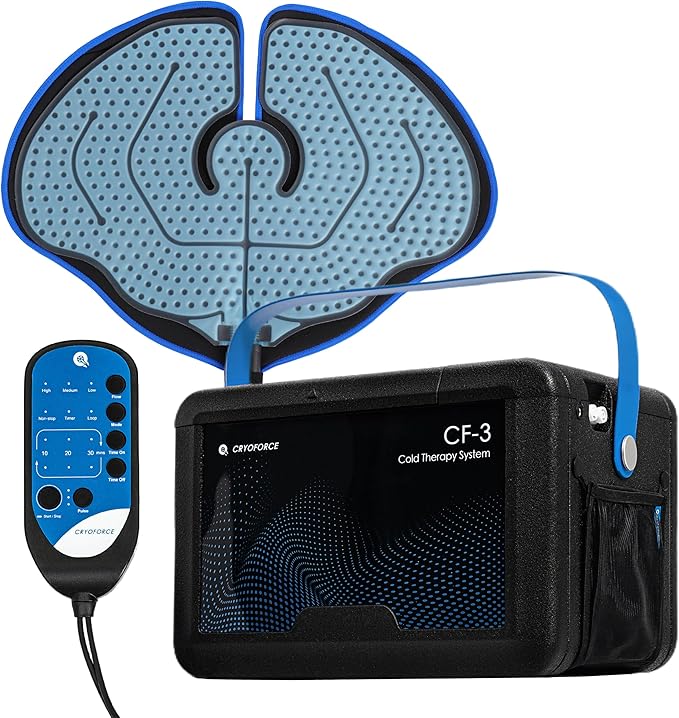
The CF-3 Pro is the workhorse of this list. Its 16.8-quart reservoir is more than double the capacity of most knee-focused units, which matters when you want a 20-minute session on the left quad, immediately followed by 20 minutes on the right, without re-icing the chamber. The pad is large enough to extend well above the kneecap and cover the distal half of the vastus medialis—exactly where a strained VMO complains. Cyclists logging 12+ hours a week, training-camp blocks, or back-to-back race weekends will get the most out of this one. Check the CF-3 Pro on Amazon.
2. CF-1 Quiet Cold Therapy Machine — best for bedroom and apartment use
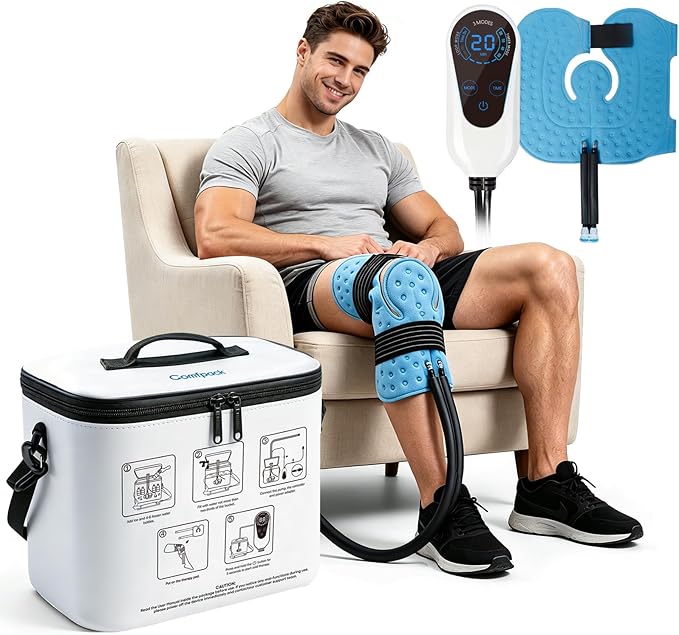
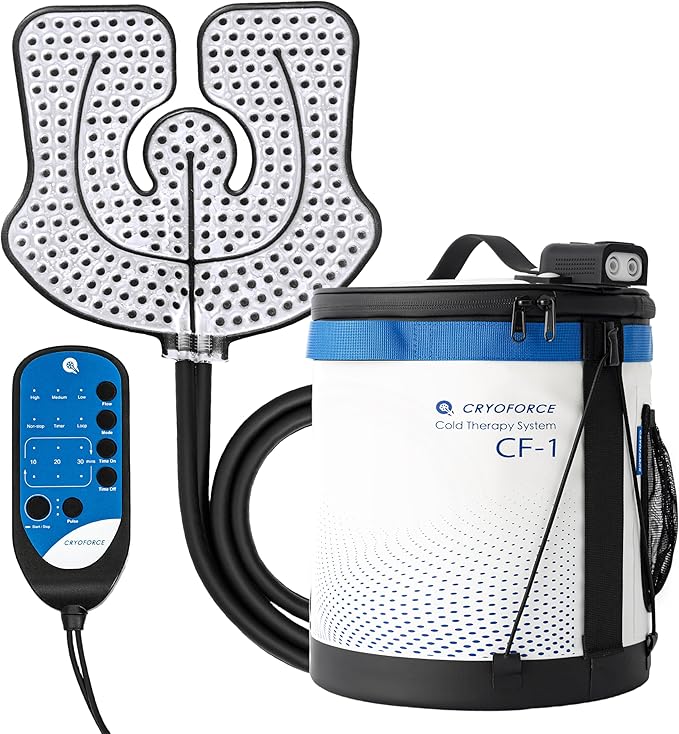
If you ice late at night, share a room, or live in a building where a noisy pump is going to start an argument, the CF-1's quiet motor is the standout. It's smaller than the CF-3 Pro, which means more frequent refills if you do double sessions—but the trade-off is a unit you can actually run while reading a book or watching a stage of the Giro. The pad geometry is shared with the rest of the line, so VMO coverage is solid as long as you position the cuff a few centimeters higher than the included instructions suggest (they assume a post-op knee, not a cyclist's thigh). See the CF-1 on Amazon.
3. Cold Therapy Machine for ACL/Knee Recovery — best budget pick
This one shows up under several listings; the ACL recovery variant gives you the basic pump-circulated cold experience without programmable timing. For cyclists who already own a kitchen timer or use their phone, that's not a real loss. The pad runs slightly smaller than the CF-3 Pro's, so taller riders or anyone with a long femur should plan to scoot it upward and add a compression sleeve over the top to keep VMO coverage tight. Reliable and cheap—a fair entry point if you're not yet sure cold therapy is part of your long-term routine. View the ACL recovery ice machine on Amazon.
4. Portable Cold Therapy Machine with Programmable Timer — best for race travel
The portable, timer-equipped unit is the one to throw in the back of a team car for a stage race. Smaller footprint than the CF-3 Pro, programmable so you can set it and nap, and light enough to carry into a hotel room without throwing out your back. Reservoir capacity is mid-pack, which is fine for a single 20-minute VMO session—just plan on a refill if you want to do both legs. Cyclists who travel for gravel events, gran fondos, or stage races will appreciate the size-to-functionality balance here. Check the portable model on Amazon.
How to actually use cold therapy quad wraps for cyclists with VMO strain
Cold therapy is a tool, not a cure. Here's how to get the most out of these machines in a cycling-recovery context:
- Position the pad above the kneecap. Slide the cuff so the upper edge sits 3–4 finger-widths above the patella. This is the most common mistake cyclists make—centering the pad on the knee misses the VMO's belly entirely.
- Use 15–20 minute sessions, never longer. Skin desensitizes quickly. Beyond 20 minutes you risk nerve irritation and aren't getting additional anti-inflammatory benefit.
- Ice within 2 hours of the ride that triggered the flare-up. The inflammatory cascade peaks at hours 4–8, so getting cold therapy in early matters more than total minutes.
- Repeat 2–3 times per day for 48 hours. Then taper. Daily prophylactic icing is mostly placebo for cyclists who aren't actively flared.
- Compress while cold. All four machines above include compression sleeves around the pad—use the Velcro snug, not loose. Compression is doing as much work as the cold.
If you're weighing a recovery setup more broadly, our guide to cold plunge tubs versus circulating ice machines for cyclists walks through which tool wins for which kind of soreness, and our roundup of portable ice baths for race travel covers the budget end of the cold-therapy spectrum.
Who should skip these machines
If your VMO strain is actually patellofemoral pain, a meniscus issue, or a true muscle tear, cold therapy quad wraps for cyclists with VMO strain will only mask the symptom. A few flags that mean see a sports medicine doctor or physiotherapist before buying anything:
- Sharp pain on the inside of the knee that gets worse, not better, with rest.
- Swelling that doesn't respond to a 48-hour ice and rest cycle.
- Locking, clicking, or instability when descending stairs.
- Numbness or pins-and-needles along the inner thigh.
Frequently Asked Questions
How long should I ice my quads after a long ride?
Stick to 15–20 minute sessions and never more than three in a 24-hour window. Cycling-specific VMO flares respond best to icing within two hours of the ride, then again before bed. Longer sessions don't add benefit and increase the risk of skin and superficial nerve irritation.
Are cold therapy machines better than ice packs for VMO strain?
For a single 10-minute knock-down, an ice pack is fine. For consistent 20-minute sessions at a controlled 40–45°F across the entire VMO belly, a circulating machine wins. The pump keeps the pad temperature constant, where bagged ice gets noticeably warmer in the middle of the wrap within 6–8 minutes.
Can I use a knee cold therapy machine on my quad?
Yes—and most cyclists should. The knee/thigh wraps included with the units above are large enough to cover the distal third of the quadriceps when positioned correctly. Slide the pad 3–4 finger-widths above the patella so the upper edge sits over the VMO. Strap it snugly with the included compression sleeve.
Should I ice before or after a ride if my VMO is bothering me?
After. Pre-ride icing reduces proprioceptive feedback and can mask warning pain that protects you from a worse injury mid-ride. If you're actively flared, the better pre-ride strategy is a dynamic warm-up, terminal knee extensions, and KT tape; save the cold therapy machine for the recovery window.
What's the difference between VMO strain and patellar tendonitis in cyclists?
VMO strain hurts along the inner edge of the upper kneecap and the lower inner quad—it's a muscle-belly ache. Patellar tendonitis hurts directly below the kneecap on the tendon itself and is sharper, more localized. Both respond to cold and rest, but the rehab work is different—VMO needs strengthening, tendinopathy needs progressive loading.
How often should I replace the water in a cold therapy machine?
Every session if you're sharing the machine, every 2–3 sessions if it's just you. Stagnant water in the reservoir grows biofilm over a week, which can clog the pump and shorten the unit's life. Empty and air-dry the reservoir if you're storing the machine for more than 48 hours.
Is cold therapy safe for everyday training, or only injury flare-ups?
For VMO strains, prioritize cold therapy during active flare-ups and the 48 hours after big rides that aggravate the area. Daily icing during normal training blocks may actually blunt some of the adaptive inflammation your body uses to get stronger. Use the tool when it's earning its keep, not as a daily ritual.
Bottom line
The right cold therapy quad wraps for cyclists with VMO strain in 2026 are large-pad, pump-driven, programmable systems—not the gravity-fed bags of a decade ago. For most riders the CF-3 Pro 16.8QT is the right call thanks to its reservoir size and pad coverage. Apartment-dwellers and travelers should look at the CF-1 or the portable programmable unit instead. And remember: cold therapy buys you a faster window to get back to the work that actually fixes the imbalance—single-leg strength, terminal knee extensions, and bike-fit corrections that put the VMO back in the firing pattern.
Key Takeaways
- Choosing the right cold therapy quad wraps for cyclists with VMO strain means matching capacity and output ports to your actual devices
- Always check actual watt-hours (Wh), not just watts — runtime depends on Wh, not peak output
- Also covers: cycling quad ice wrap vastus medialis
- Also covers: VMO strain cold compression wrap
- Also covers: cyclist thigh cold therapy wrap
- Compare price-per-Wh across models to find the best value for your budget